

 عربی
 فارسی
What is Ozone?
1565778 Views
What Is Ozone? Applications, Properties, and Benefits of Ozone
Ozone is a gas that most people commonly associate with the thin layer above the Earth's atmosphere that protects us from the sun's ultraviolet rays. However, this blue gas, sometimes described as having a "fresh smell" after lightning, has various applications on Earth.
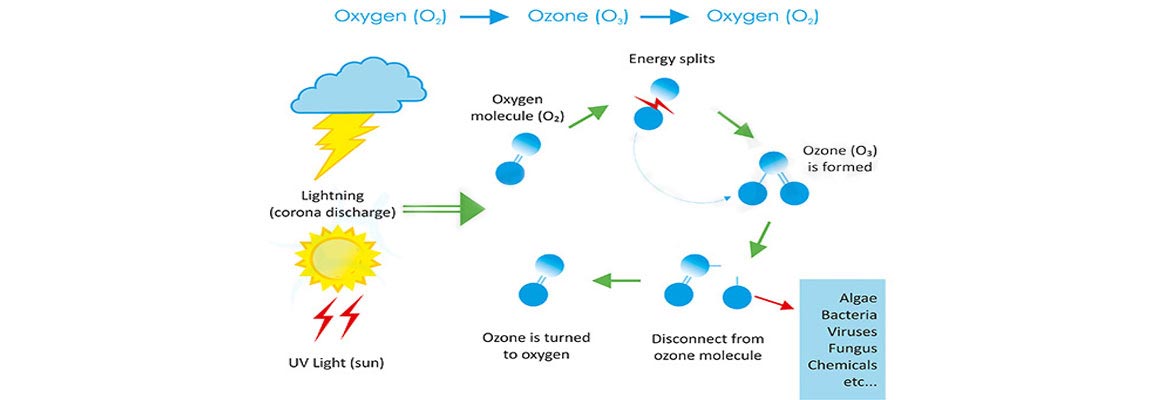
Ozone is composed solely of oxygen. It can be visualized as a regular O2 molecule with a highly reactive, energetic, and unstable single O1 atom. This O1 atom does not prefer to exist alone and tends to stabilize by bonding with another O2 molecule, forming ozone (O3). Ozone is injected into water or air, where its strong oxidizing properties help destroy cell walls, inactivate microorganisms, and oxidize certain metals and other compounds in water.
High-frequency ozone production has several benefits, including reducing the size of ozone generators and enabling high-capacity, high-concentration ozone production. Advanced voltage system and ozone reactor designs at Rashkiyan help optimize reactor performance. Air-cooled models can also achieve high production capacities, depending on their configuration and operating conditions.
How Does Ozone Work?
Ozone is a strong disinfectant and oxidizer, affecting pathogens and contaminants through oxidation, disinfection, chemical transformation, or removal. It is one of the strongest oxidizing agents used in water treatment, with an oxidation potential second only to fluorine among commonly referenced oxidizing agents.
Compared to chlorine, one of the most common water disinfectants, ozone has a higher oxidation potential and can react significantly faster under suitable conditions. However, actual treatment performance depends on the type of contaminant, ozone concentration, contact time, and water quality. Both chlorine and fluorine are highly reactive chemicals and require careful handling.
For over a century, ozone has been used to purify drinking water in Europe. In the United States, ozone is also used in bottled water production and cooling tower disinfection. Los Angeles, for instance, has used ozone as part of its water treatment processes. Ozone's applications are not limited to drinking water.
On June 23, 2001, the U.S. Food and Drug Administration (FDA) officially granted ozone GRAS (Generally Recognized As Safe) status for use in food contact applications. With regulatory recognition, food processors increasingly adopted this technology in their facilities.
Today, ozone technology is used in processing meat, poultry, seafood, and fresh produce as a method of supporting food safety management. Food processors recognize that properly controlled ozone treatment can help extend the shelf life of their products, a crucial advantage in today's competitive global food industry.
History of Ozone
-
1840: Discovered by Christian Friedrich Schönbein.
-
1893: Used as a disinfectant in drinking water treatment.
-
1909: Used as a food preservative for frozen meat.
-
1939: Found to help prevent yeast and mold growth during fruit storage.
-
1982: FDA GRAS declaration for bottled water applications.
-
1995: FDA GRAS status for ozone use in bottled water remained unchanged.
-
1997: Industry experts confirmed ozone's GRAS status and its compliance with FDA requirements.
-
1999: USDA rejected an ozone protocol for meat processing, citing the 1982 GRAS declaration, which specifically concerned water applications.
-
2000: A Food Additive Petition concerning ozone use in water and air applications was under preparation for submission to the FDA.
Applications of Ozone in Water Treatment and Disinfection
One of the most important applications of ozone is in water treatment and disinfection. Due to its strong oxidizing properties, ozone can react with a wide range of organic compounds, microorganisms, and certain contaminants present in water.
For this reason, ozone is used in many water treatment systems as an effective treatment stage to reduce contamination and improve overall water quality.
Unlike some chemical disinfectants, ozone decomposes after reacting and eventually breaks down into oxygen. This characteristic has made ozone an attractive option for various water treatment applications.
However, proper system design, ozone dosage, contact time, and the quality of the incoming water are essential factors in ensuring effective ozone treatment.
The Role of Ozone in Reducing Water Contamination
In addition to its disinfecting properties, ozone plays an important role in the oxidation of certain compounds present in water.
Substances responsible for unpleasant odors, color, and other water quality issues can be affected by ozonation under suitable operating conditions.
Therefore, ozone applications are not limited to disinfection alone. In advanced water treatment processes, ozone is also used as part of an oxidation stage to improve water quality.
The appropriate ozonation method should be selected based on the type of water, contamination level, and specific treatment objectives.
Ozone Applications in Various Industries
Ozone applications extend far beyond drinking water treatment. This technology is also used in several industries, including food processing, aquaculture, swimming pools, wastewater treatment, and various industrial processes.
In the food industry, properly controlled ozone treatment can help reduce certain microbial contaminants and extend the shelf life of products.
In aquaculture, ozone can improve water quality and help control part of the microbial and organic load within the system. This is particularly important in Recirculating Aquaculture Systems (RAS), where water is continuously treated and reused.
Ozone in Aquaculture and Recirculating Aquaculture Systems (RAS)
In Recirculating Aquaculture Systems (RAS), water quality plays a critical role in the health, growth, and survival of aquatic organisms.
Ozone can be used as a supplementary treatment technology in these systems. Through the oxidation of organic compounds and the reduction of certain contaminants, ozone helps maintain and improve water quality.
However, ozone application in aquaculture requires careful system design and continuous monitoring of residual ozone levels. Excessive ozone concentrations can be harmful to fish and other aquatic organisms.
Therefore, an ozone treatment system should be designed according to several project-specific factors, including water volume, flow rate, species of fish, organic loading, and the performance of other water treatment equipment.
Why Is Ozone System Design Important?
The performance of an ozone generation system does not depend solely on the production capacity of the ozone generator.
Several factors influence the overall efficiency of an ozone treatment system, including ozone production capacity, ozone transfer and injection methods, contact time, water quality, temperature, pH, and residual ozone monitoring and removal.
Selecting a standard ozone generator without evaluating the actual project requirements is not always the most effective solution.
A properly designed system should be based on the intended application and specific operating conditions. This approach helps achieve the desired treatment performance while avoiding unnecessary energy consumption and additional operating costs.
Choosing the Right Ozone Generator for Your Project
Ozone generators are available in different capacities and configurations. Selecting the right model depends on the intended application and the specific requirements of the project.
For example, an ozone generation system designed for industrial water treatment may have completely different capacity requirements and installation specifications compared with a system used in aquaculture or swimming pool disinfection.
In industrial projects, several factors should be considered in addition to ozone production capacity, including equipment quality, cooling system design, ozone injection methods, monitoring and control systems, and operational safety.
Choosing the right ozone generation equipment can have a direct impact on treatment efficiency, operating costs, and long-term maintenance requirements.
Ozone: A Technology for Contamination Control
Today, ozone technology is widely considered a valuable solution for various water treatment and disinfection applications due to its strong oxidizing properties and versatility.
However, ozone is a specialized treatment technology, and achieving optimal results requires proper control over its generation, injection, and concentration according to actual project conditions.
Whether ozone is intended for water treatment, aquaculture, RAS facilities, food processing, or other industrial applications, evaluating project requirements before selecting an ozone generator is essential.
Consultation and Ozone System Design
Rashkiyan Caspian specializes in solutions related to water treatment and disinfection, helping customers evaluate their project requirements and select suitable ozone treatment systems.
Factors such as required ozone production capacity, water characteristics, intended application, and operating conditions are considered when selecting and designing an appropriate ozone generation system.
For technical consultation and information about ozone generation equipment, contact the Rashkiyan Caspian team.
Frequently Asked Questions About Ozone
Answers to the most common questions about ozone, its applications, and its properties
What is ozone and how is it produced?
Why is ozone considered such a powerful disinfectant?
What are the main industrial applications of ozone?
- Treatment and disinfection of drinking water and wastewater
- Aquaculture ponds and RAS (Recirculating Aquaculture Systems)
- Air disinfection in industrial and hospital environments
- Food packaging and preservation
- Industrial wastewater treatment and odor removal
Is ozone exposure harmful to human health?
How do I choose the right ozone generator for my project?
Choose the Right Ozone Generator for Your Project
If you are looking for a reliable ozone solution for water treatment and disinfection, aquaculture, RAS systems, or industrial applications, the experts at Rashkiyan Caspian are ready to assess your project requirements and recommend the right solution.
Contact Rashkiyan Caspian for consultation and a quote on ozone generators.
Call Rashkiyan Caspian: +98 13 3443 7527